Saint-Émilion
where WSET theory comes to life
It’s a very intimidating feeling, because I kept wondering: what could I possibly add in terms of content? Especially since I didn’t fully grasp all the history, topography, classification systems, and appellations, etc.At school (WSET), it was extremely hard for me to understand the underlying logic and memorize the names of all those famous villages—Pauillac, Pomerol, Pessac, Margaux, Saint-Émilion, Saint-Estèphe, and so on. So I learned them mechanically, hoping that one day I’d get there myself, see everything with my own eyes, and maybe all the mysteries would finally clear up.
That day came at the end of May this year, when we decided to spend our first vacation in France, some of us exploring, others learning  , in a few of France’s most celebrated wine regions: the Loire Valley, Bordeaux, and Burgundy.I already shared about the Loire here
  Loire Valley, but after a few weeks, I finally mustered the courage to put my memories and impressions from our short stay in Bordeaux into words.So, let’s start with the “right” bank and dive into one of the most famous appellations on that side: Saint-Émilion.
Saint-Émilion by the Numbers: 800 Châteaux and 5% of Bordeaux’s Magic
We absolutely have to look at the map and notice how the Gironde estuary shapes the landscape and then splits into its two arms: the Garonne and the Dordogne. These two rivers are crucial for the grape varieties grown, the aromas, the structure, and, of course, the terroir of the wines.
 ).
).That sounds like a lot at first glance, but… when you consider the total wine production of the entire Bordeaux region, Saint-Émilion accounts for just 5%. It also stands out with its own classification system, because why not
 ?
? At school, I was told not to look for logic, because there isn’t any… it’s all historical, and the approach has somehow persisted over time for various reasons.
The drive from Bordeaux to Saint-Émilion is fairly quick, just 45 minutes by car, right near the Dordogne River.
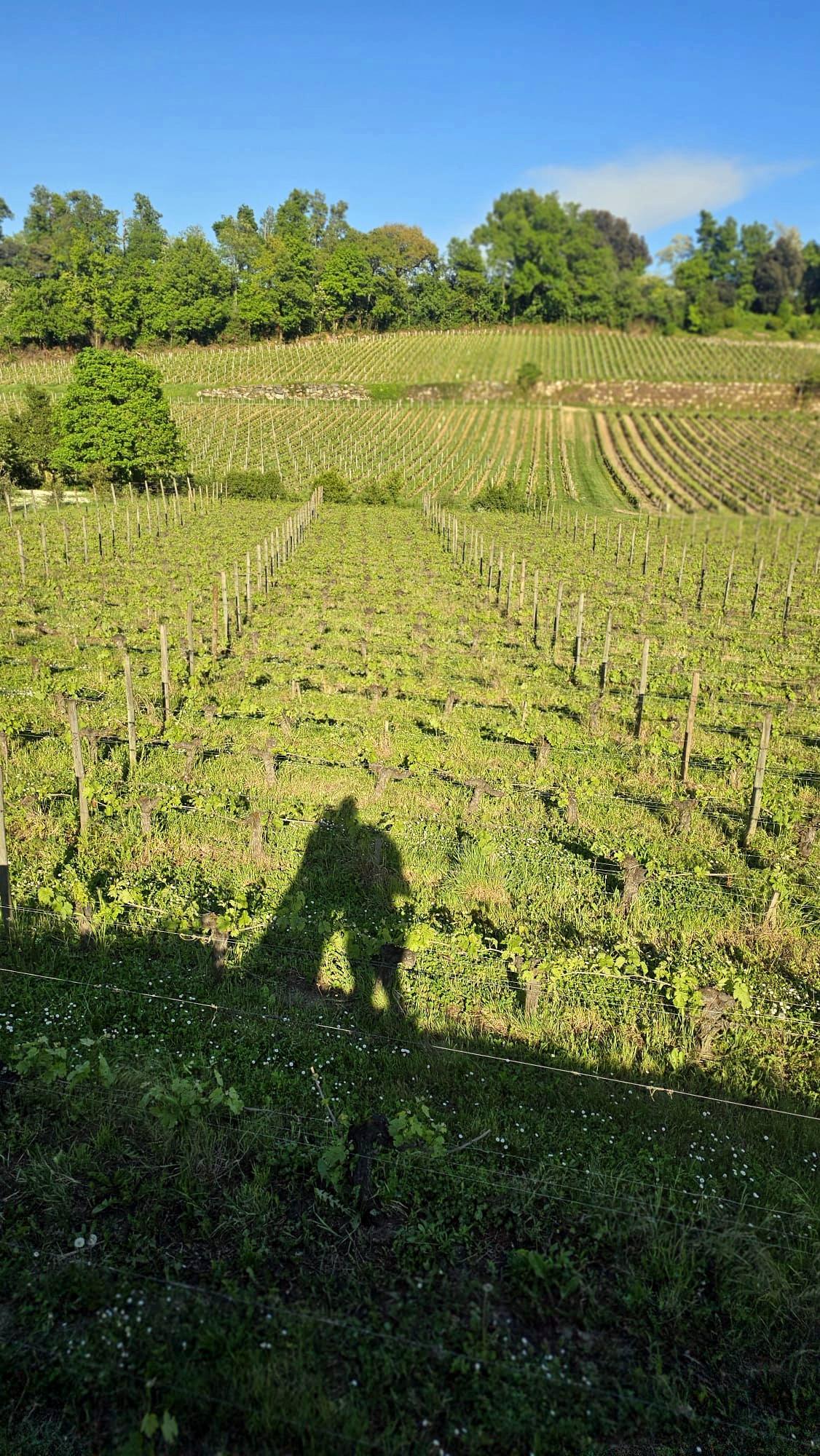
As we got closer, the landscape was already changing… hills appeared, and vineyards stretched as far as the eye could see. Dreams do come true  .
.

Peisaj de vie în timpul zilei, cu cer clar și rânduri de vie bine întreținute.
A medieval gem of a town, listed as a UNESCO World Heritage Site, became the first “vineyard city” (if we may call it so) to receive this designation in 1999, and also the first city in the region to export wine.
*Although history shows that Saint-Émilion has an extremely rich winemaking tradition going back as far as 56 BC, when the first amphora was discovered here.
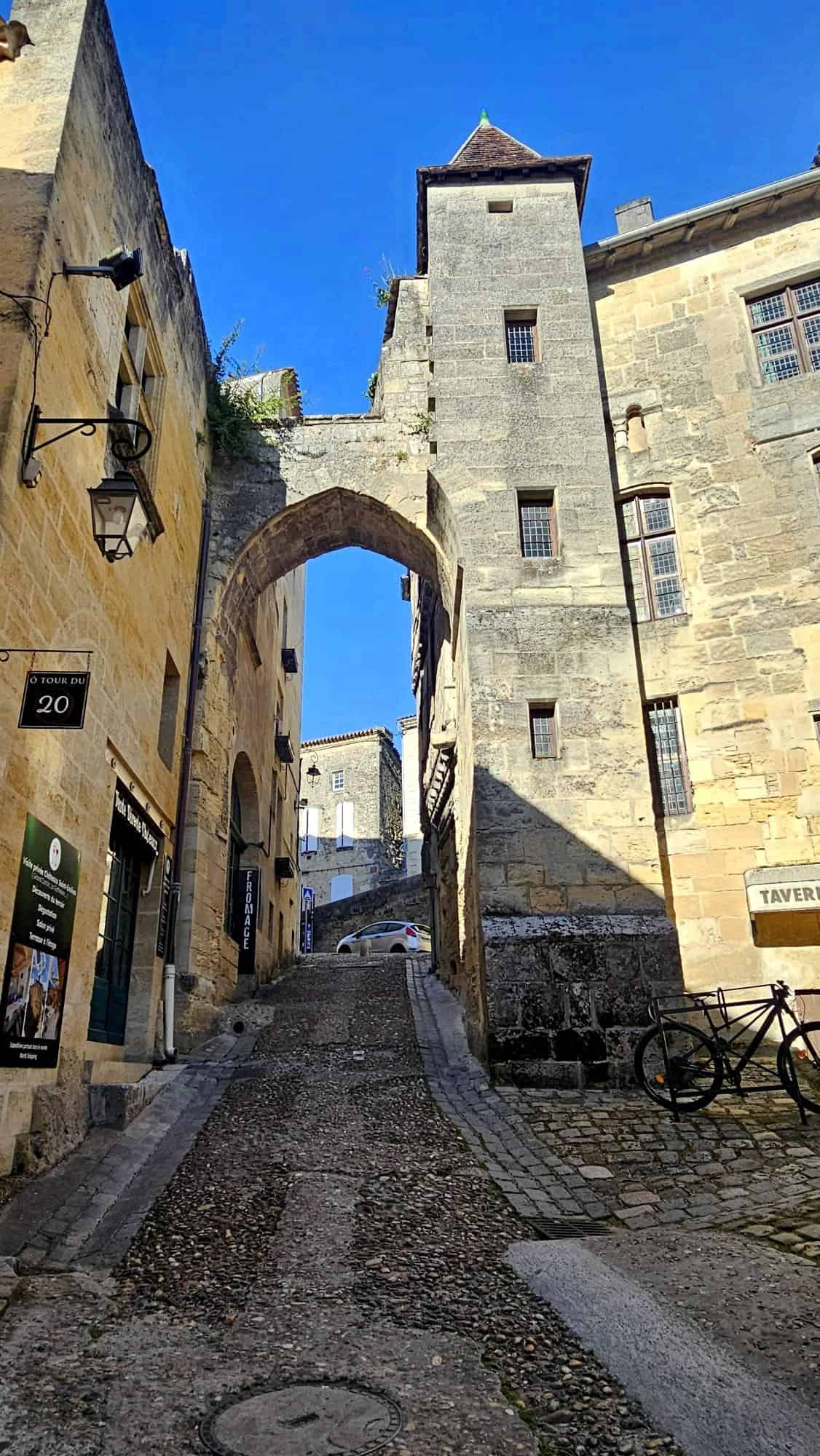


A LITTLE HISTORY…
The Roman Empire, Christianity, pilgrims, monastic orders, royal families, revolutions, the Napoleonic Wars… all these factors have left a massive imprint on the history of Bordeaux and its right bank.
Thanks to its reputation and constant demand from England, Flanders, and the Netherlands in the 17th century for Saint-Émilion wine, the town grew in size, more plots and parcels appeared, ownership multiplied, and the land continued to fragment.
That lasted until the 19th century, when… game over… phylloxera hit the scene and wiped out nearly half the vineyard area, not just in Saint-Émilion, but across Europe (learn more about the infamous insect here Phylloxera – Hard To Kill, the viticultural version).
Fame faded, quality and production became extremely limited, many châteaux disappeared, and the situation persisted until a “cure” was found for the deadly pest and the classification system for Saint-Émilion wines was introduced (1955), putting the region back on the viticultural map.
GOOD TO KNOW
Before I tell you about the wonders we saw and tasted in Saint-Émilion, a few quick observations:
- The most important characteristic (shaped by everything mentioned above) is the grape variety grown: RED*. The right bank is famous for softer blends, aromatic profiles, silky tannins, and a stronger emphasis on fruit, Merlot dominates as the red grape (79%), followed by Cabernet Franc (15%), and in very small amounts: Cabernet Sauvignon, Petit Verdot, Carmenère (widely planted in Chile), Syrah, and Malbec (Argentina’s signature grape).
*This doesn’t mean white varieties aren’t grown on the right bank; in the past, they were quite common in Saint-Émilion, but now they’re rather rare. - Merlot at “home”: Merlot originated near the town of Libourne (very close to Saint-Émilion) and has a charming backstory. It’s said to come from the French word “merle,” which translates to “blackbird” in English (apparently, blackbirds loved Merlot berries, hence the connection). It’s the result of a cross between Cabernet Franc and an obscure local variety (which probably no longer exists), called Magdeleine Noire des Charentes.
- Climate: temperate-oceanic, quite variable, and differs from micro zone to micro zone, warmer with oceanic influences in the south, cooler and rainier in the northeast. So the climate is so diverse that a good vintage on the right bank doesn’t automatically mean a good one in Médoc (the left bank).
- Soil: extremely varied, but clay, limestone, sandy, and loamy soils (red and brown) dominate. They act like a sponge, retaining and releasing just the right amount of water when needed, perfect for delicate Merlot and great for intensifying fruity notes.
- Terrain: gently elevated but also flat. I mentioned those hills as we approached the town… hills mean different vine positioning, different soils, shade patterns, etc. That’s why the plateau parcels (around the town of Saint-Émilion and in the north) are the most valuable—thanks to sun exposure and soil quality.
- Vines: again, shaped by the soil. Roots go very deep, and if they spread far enough, they perfectly transmit the area’s minerality and terroir → resulting in complex, rich wines. In size and height, the vines are very small compared to other wine regions I’ve seen, but I’ll explain why in another post → stay tuned.


LET’S GET DOWN TO BUSINESS

And because we clearly don’t learn from our mistakes, we doubled down on our “spontaneous” approach from the Loire Valley. Once we arrived in Bordeaux, we were hit with the same disappointment: almost every vineyard and château we had our eye on required advance bookings.
That’s exactly what happened at our first stop in Saint-Émilion, Château Chatelet, which very politely sent us packing when we asked if we could do a walk-in tasting.
Undeterred, we moved on to Château La Croizille, which turned out to be far more welcoming to clueless tourists (like us  ) and happily squeezed us in for an impromptu tasting.
In the photo below, I tried to capture a slice of the absolutely magical landscape that unfolded in front of us from the château’s terrace, where we did the tasting.
We learned that the Saint-Émilion estate actually includes two properties: Château La Croizille (the newer one) and Château Tour Baladoz (the older), positioned more or less facing each other (which, again, threw us off a bit—Google showed one name, but the building had another). Both belong to a Belgian-French family of négociants, the De Scheppers (Maison de Mour).
Small in size, just 5 hectares (as I mentioned earlier), but living proof that good things come in small packages, Château La Croizille is classified as a “Grand Cru Classé,” a label that screams prestige, top-tier quality, exceptional terroir, and, of course, rigorous evaluations.


We choose the “Terroirs” package of 5 wines for €25, where we sample 1 Bordeaux blend, 2 Saint-Émilion Grand Cru, and 2 Margaux wines (the De Schepper family owns several vineyards in the Bordeaux area, including on the Left Bank).
I’m still wondering whether I picked the right package , not because of the wine quality, which was exceptional
  , but because I wanted to focus 100% on the Right Bank, to better understand the profile of Saint-Émilion wines. Mixing them turned out to be a blessing 😅.
Two treasures we tasted remain the most beautiful “memory”: fine notes of blueberry, blackberry, and dark chocolate, black pepper, vanilla, leather, and smoke, both aged in French oak and leaving a storybook-length finish.

DELIGHTS AND TREATS
We left “tipsy” (with happiness ) toward the town to find a wine bar/wine restaurant and stopped at Ô 3 Fontaines, where we tried our first foie gras and a divine duck confit paired with some wine wonders (which we also bought from the wine shop next to the restaurant):
Château Tour St Christophe – Les Terrasses 2022 & Château Bellefont-Belcier – Les Tours de Belcier 2018


After strolling around the little town’s streets for a good few hours with our “loot” (the car parked at the entrance), we triumphantly retreated to the wine hotel we’d booked via Booking: Château de Seguin.We’d set out to have “different” accommodations on our France trip, we dreamed of spending a night in a château.
Lord, I was thrilled , especially after seeing the photos, location, and rating on Booking. The disappointment hit when we checked in and realized it was… sort of a château, but in an apart-hotel setup.
Meaning: no reception, we checked ourselves in after receiving instructions (in French) via Whats App; no restaurant (we’d hoped for dinner, but ended up eating cheese puffs from the car); and we were completely isolated—no staff anywhere nearby. The room was spacious, with some “unique” mementos that were probably inspired by events that weren’t exactly… positive.

If we’d ever return to Saint-Émilion: Yesterday!
 )
)Food ★★★★★ (what a feast… what mastery… what an experience… I’m still dreaming about that 🦆🤤 )

The journey doesn’t end here…
 The journey doesn’t end here…
A Few Tips & Tricks (Learned from Our Mistakes)
- Plan ahead
- Aim for April, May, September, or October (August is not only scorching hot, but pretty much everyone in France is on vacation and most vineyards are closed)
- Be careful with accommodations: book hotels in advance (with free cancellation) and note, just because it says “château” doesn’t mean it’s actually a castle
- Map out your itinerary (route, stops, speed limits, etc.)
- Book tastings in advance (many vineyards allow online scheduling right on their websites)
- 2–3 wineries per day is more than enough (you’ll feel it after a few days)
- Watch the legal alcohol limit if driving (0.5 g/L)
- Don’t feel obligated to buy bottles after tastings, especially given Bordeaux’s rather steep prices
- I thought about saying “brush up on your French,” but honestly, it’s pointless. despite my efforts to dust off my kindergarten and baccalaureate French and speak as much as possible, I still got answered in English
- Budget: tastings start at €25/person and up; meals average around €40/person at restaurants (appetizer, main, dessert, drinks), though we also had days where we happily grabbed just a plain baguette with Camembert… why not?
- In Saint-Émilion, you can generally walk to the wineries once you’re in town, but some are 2–3 km outside, so come prepared with the right outfit

More tips & tricks here https://vinovidivici.ro/good-to-know/